Customer Lifetime Value (CLV) – Introduction, analytics, and reporting of customer value with practical examples from Happybrush and claro products
The customer lifetime value (CLV) of an acquired customer is a term regularly used in digital and non-digital retail business. For entrepreneurs and investors, this metric serves to assess the sustainability of a business model—and its future earnings potential. This article aims to build CLV expertise and provide deeper insight into the methodology and diverse areas of application in corporate management. The practical design and implications of a CLV focus are illustrated using practical examples.
Why customer lifetime value (CLV)?
Customer lifetime value – CLV for short – simply refers to the long-term monetary value of a customer. It is therefore a key issue in retail. In addition to the functionality and sustainability of the business model itself, it also provides information relevant to the management of strategic and operational measures.
Broken down to the individual customer, it is therefore the sum of all contribution margins over the period of the company’s existence minus the costs of acquiring that customer. The term “customer equity,” i.e., the value of the customer base, adds up the individual, expected future customer lifetime values of all customers acquired to date. This represents the total value of a loyal customer base that frequently purchases high-margin products and does not need to be stimulated to buy with high incentives such as discounts. This means that the customer is convinced by the offer, price, and service and returns every time they intend to make a purchase.
In the ideal scenario, advertising expenditure is only budgeted for the acquisition of new customers and thus for increasing sales, while the achieved sales and contribution margin base remains unchanged thanks to existing customers. Customer relationship management is responsible for maintaining the customer base, and the costs for this are usually only a fraction of those for new customer acquisition. This not only creates planning security, but also a significant scaling of marketing costs and means a corresponding increase in overall profitability. This increase in profitability can amount to several percentage points. If this is reinvested in the acquisition of promising new customers, sales will automatically increase. And this is achieved while sustainably building up the existing customer base.
Customer lifetime value – a change in perspective
When talking about a company’s sales development, this value is traditionally reported as an absolute or percentage change compared to a reference period. Sub-areas such as country development or those of certain product lines are presented separately.
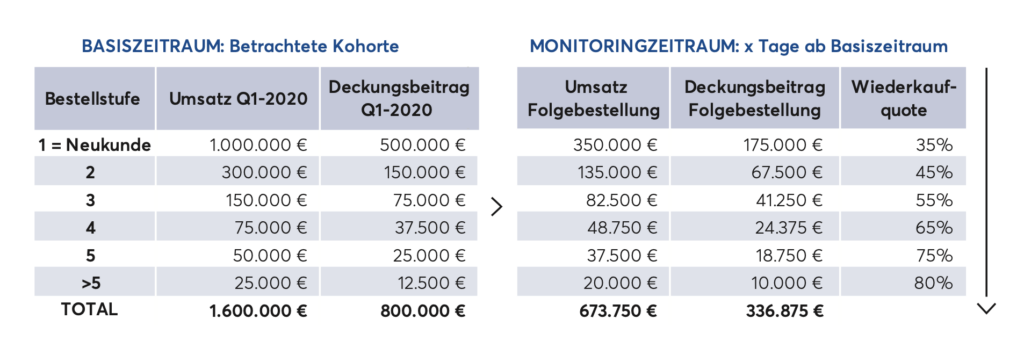
CLV logic brings a new perspective into play here, namely the customer structure of the sales achieved and the respective contribution margins. Looking at a single quarter, a distinction is first made between the order stages in which the customers are currently located (example table in Figure 1). This already provides the first relevant insight, namely the new customer revenue or contribution margin and the number of new customers.
Figure 1: Calculation of the repurchase rate per order level
The dynamic view on the timeline
The next step integrates the temporal dynamics into the calculation. Here, customers at each order stage are given a certain time frame and their further ordering behavior is observed. From this ordering behavior, it is possible to deduce the probabilities of a follow-up purchase, also known as the repurchase rate or retention rate. In addition, the average time between orders and follow-up orders is determined for each order stage, known as the cycle time, which will later become important.
Taking into account the respective average shopping carts and contribution margins as well as the probability of a repeat purchase per order level, the derivation results in customer lifetime revenue (sales) on the one hand and customer lifetime value (contribution margin) on the other. All parameters always refer to the period under consideration, in the example above to the selected quarter. On this basis, it is possible to develop both an overall strategy for several years and immediate measures and operational procedures.
CLV in practice Part 1: E-commerce
The strength of a data-driven retailer lies in its ability to make optimal use of all available information and to derive the right strategic and operational decisions from it.
In the online sector, the focus should be on customer lifetime value from the outset due to data transparency. This explains many business models that, at first glance, do not generate significant returns but present impressive annual growth figures and thus represent absolute market power.
Amazon is the well-known prime example here, but successful European players such as Munich-based zooplus AG and Zalando SE – both listed on the stock exchange – have also focused on this topic from the outset as the basis of their business model and growth strategy.
The question often asked by banks about the returns achieved is countered by the argument that this is not the main focus during the growth phase; the decisive factor is reinvestment in building up a base of regular customers. It is only with the transition from the growth phase to the stabilization phase that the potential of the business model is monetized. The only question is when the company enters or wants to enter this phase.
The economic impact: a numerical example
To illustrate the economic effect, here is a simple calculation example (Figure 2): A company with annual sales of €100 million achieves a sales retention rate of 25%. This means that in the following year, €25 million in sales will be generated by existing customers from previous years. In order to maintain the sales level of €100 million, €75 million in sales must come from new customers. The cost for each new customer is 10% of the new customer sales, so €7.5 million is spent on marketing.
Figure 2: Economic impact of higher sales retention
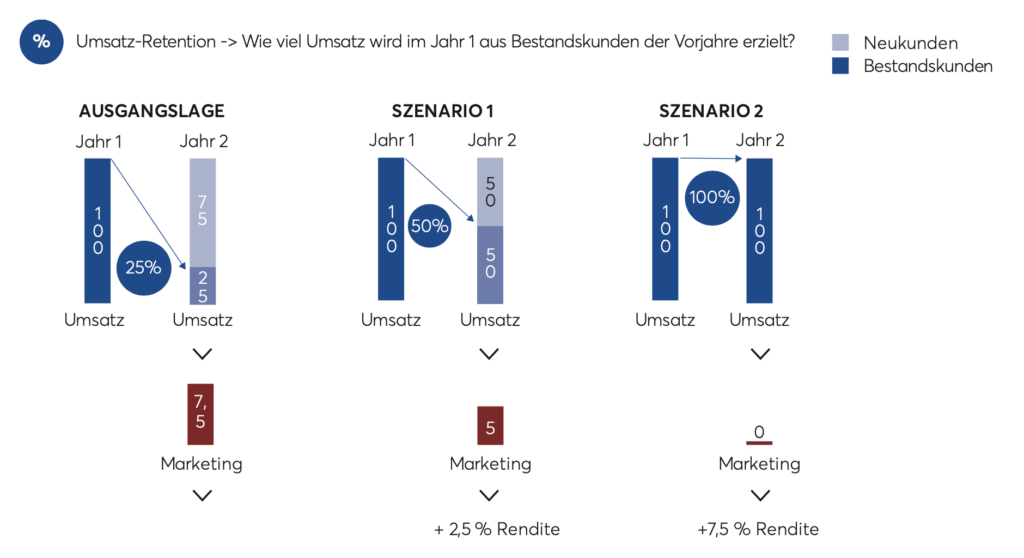
€75 million in sales come from new customers. The cost for each new customer is 10% of the new customer revenue, meaning that €7.5 million is spent on marketing.
If revenue retention is increased to 50% in scenario 1, only €5 million needs to be invested in marketing, resulting in savings of €2.5 million. And if this figure is 100% in scenario 2, the company does not need to spend anything on marketing to maintain the revenue level of €100 million in the following year. The savings would thus amount to €7.5 million compared to the initial situation. This amount represents an increase in return of 7.5 percentage points or additional new customer sales of €75 million when reinvested. In this case, the company achieves total sales of €175 million in the following year instead of the original €100 million.
A value of 100% sales retention may seem utopian, but it is entirely achievable. One example of this is the aforementioned zooplus AG. The company reports an annual rate of 97% in its current investor presentation, making it the absolute leader.
This example clearly shows that customer lifetime value is not a marginal issue, but rather the core of the
retail business model. This makes it all the more surprising that this topic is not on the agenda for many executives.
The added value does not only apply to pure online retailers. Multi-channel companies that sell their products in brick-and-mortar stores and also operate a web shop should also use their database for CLV optimization. In these cases, links such as customer accounts or discount codes are created to assign each purchase, whether in a brick-and-mortar store or online, to the customer. This is the only way to track the customer’s purchasing behavior as completely as possible.
In addition, the online store can also serve as a testing ground for purchasing behavior and product development.
From the forest to the tree – the 360° CLV analysis
The scheme for CLV analysis of the data can basically be carried out from two perspectives, which can be easily combined in the next step:
1. Customer perspective
2. Product perspective
These two main perspectives can then be used to apply filters that enable a more differentiated view and conclusions (Figure 3). The focus is always on actual behavior patterns, from which different clusters can be derived.
Figure 3: Filter options for identifying customer clusters
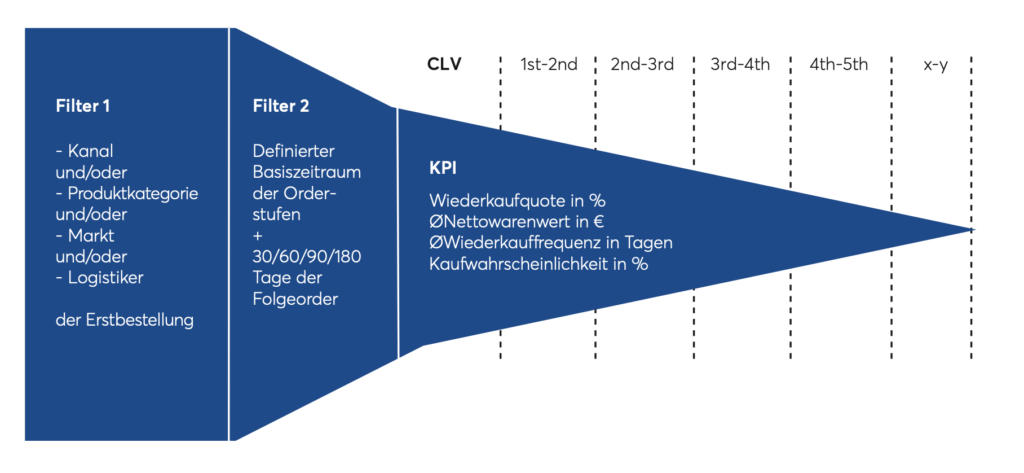
In the course of CLV analyses, it became clear to a Europe-wide e-commerce company that a customer loyalty program introduced years ago but not maintained on a sustainable basis still leads to a CLV that is 10 times higher among participating customers. An examination of the underlying key performance indicators clearly revealed the reason for this significant difference: on the one hand, there was a significantly higher shopping cart value at all order levels, which in turn made each purchase significantly more profitable due to the scaling of fixed costs such as logistics and shipping. At the same time, KPIs such as repurchase rate and frequency were also significantly better, again across all order levels. The implications for the next steps were therefore to focus fully on expanding this customer cluster with an expected return increase of 4 to 5 percentage points for the company as a whole.
CLV-style marketing – from indexing to look-alike
Marketing aims to acquire as many customers as possible at the lowest possible cost. The approach is often one-dimensional in terms of time, i.e., the lower the expenditure for acquiring a new customer, the more positively the campaign is evaluated. This
view is misleading in that it does not take into account the further development of these customers. For example, a customer may purchase a product with a low product margin on their first purchase, but over time they may develop into a loyal regular customer whose cumulative contribution margin significantly exceeds that of the supposed top customer on their first purchase. Linking marketing campaigns to the customer lifetime value of the customers generated allows for much more differentiated conclusions to be drawn about the profitability of individual campaigns (Figure 4).
Figure 4: CLV analyses of various marketing campaigns (example)

At the same time, CLV analysis of marketing activities enables behavior-based clustering of existing customers, who are in turn classified according to top, medium, and low CLV efficiency.
The information obtained from this can be processed in two ways:
- Search, address, and acquire customers who, based on their profile and activities, match those of the top
- Individualization of the approach to active existing customers based on their previous behavior patterns
While the (performance) marketing department is responsible for the first component of acquiring new customers who are future top CLV customers, customer relationship management is fundamentally concerned with optimizing the existing customer base. Both areas are intertwined, as even within the existing customer base, those with potential for further development can be filtered out.
CLV in practice Part 2: Sustainable customer acquisition
Happybrush GmbH is a provider of oral health care products and sells electric toothbrushes and oral hygiene products made from sustainable materials under its own brand. Its sales channels include brick-and-mortar stores and its own online shop. This is precisely where the company comes in, using the information generated to build a competitive advantage in both customer acquisition and customer retention, in addition to positioning itself as a socially sustainable and technically innovative brand.
The term “look-alikes” to describe customers who correspond to those in the top CLV clusters is only partially correct. Similar education, standard of living, or demographics do not necessarily mean the same purchasing behavior. The term “do-alikes” would be more accurate, as it directly refers to the similarity in the target group’s behavior.
This results in several clusters of preferred customer groups that act largely homogeneously within the segment and are also linked by one or more characteristics that enable them to be addressed. A specific marketing mix is defined precisely for the respective characteristics of each cluster. The measurability of the success of these campaigns is a decisive advantage, as this allows for continuous optimization.
Thanks to this method, new customer acquisition no longer works according to the scattergun approach. A higher marketing investment is also conceivable in the first step, as a potentially more expensive campaign now will pay off with a significantly higher return on investment over time. Happybrush GmbH thus not only produces sustainable products, but is also gradually building up a sustainable customer base.
Predictive analytics – leveraging existing potential
Identifying the top CLV customers already proven analytically also enables a differentiated view of the existing customer base and allows conclusions to be drawn about the potential that can be expected here. Predictive analytics, i.e., mathematical models for predicting future CLV potential,
can also be used to identify “high potentials” when acquiring new customers. These can then be specifically promoted in order to accompany the customer on their way to becoming a regular customer right from the start. The spectrum ranges from individualized communication and accelerated package delivery to preferential treatment by customer service in the event of complaints.
There are various methods for predictive analytics, depending on requirements and data availability. In addition to linear regression as a common calculation method, methods such as clustering or the NBD/Pareto model are also used.
The objective is always to anticipate parameters such as repurchase rate, cycle time, and sales and contribution margin development, ideally for each newly acquired customer.
CLV in practice, part 3: Environmentally conscious customer loyalty
Austrian company claro products GmbH, a manufacturer and brand developer of eco-friendly products such as dishwasher tablets, has also discovered the power of numbers. After the German consumer organization Stiftung Warentest named the classic tabs as the test winner last year, a customized customer loyalty strategy had to be developed in response to the massive increase in demand in the online shop in order to use the sudden awareness on the German market as a springboard for further market development.
These new customers, acquired without major marketing investments, had one thing in common: their
entry-level product was mostly the test-winning product. This affiliation with fast-moving consumer goods makes it possible to accurately estimate the time until a new need arises. And this is exactly where CLV can be applied.
The perfect moment – personalized communication
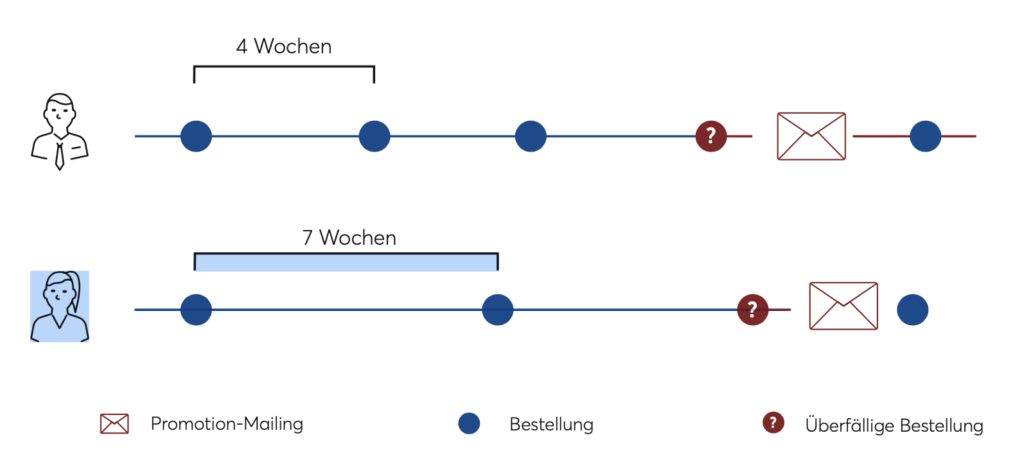
The cycle time mentioned above, i.e., the time between orders, always depends on customer needs. And this is precisely where the dependency on the product range offered comes into play. Both claro and Happybrush benefit from a predictable cycle. Dishwashers are characterized by a reliable consumption time with unchanged washing behavior, and electric toothbrushes also need to be fitted with new brush heads at regular intervals. In the case of electronic items, on the other hand, the cycles are not predefined per se, but the CLV evaluation by individual segments enables a sufficiently accurate forecast of the average time of a repurchase – and that at the customer level.
Once this critical point in time has been defined, individualized measures can significantly increase the probability of purchase in advance. On the other hand, customers who, according to the definition or statistics, should already have placed their order can be addressed or incentivized separately and in a tailored manner. This results in an increase in the repurchase rate, which in turn automatically increases customer lifetime value (Figure 5).
Figure 5: Cycle time, overdue orders, and customer communications
Reporting and visualization
For the operational translation into active control, it is crucial to focus on the key drivers in reporting. In addition to monitoring key figures over time at an aggregated level and using a corresponding traffic light system to indicate undesirable developments, the focus from a control perspective must be on the quality of new customer acquisition and the further development of existing customers. Looking to the future is always an essential part of the presentation.
This subdivision should also be reflected in the structure of the dashboards (Figure 6). The quality of acquisition activities is measured by presenting the expected CLV for new customers and comparing it with the criteria of the top CLV clusters of the existing customer base. This also allows future sales and contribution margin development to be extrapolated.
Figure 6: CLV reporting dashboard
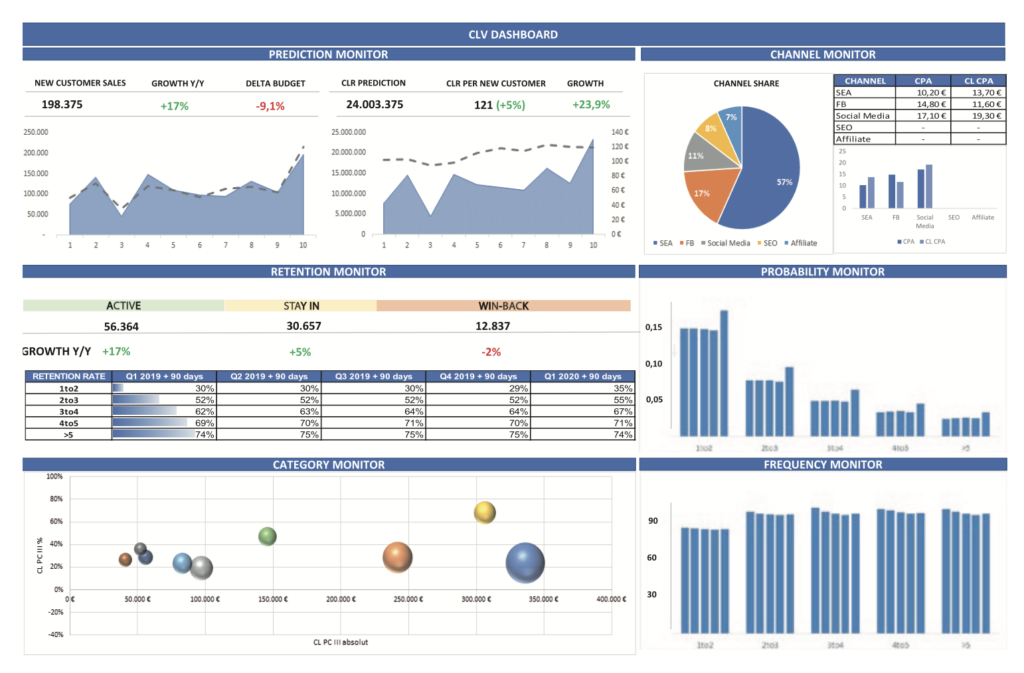
Factors such as repurchase rate and cycle time are crucial for assessing the performance of existing customers. While the repurchase rate of the individual order stages is shown over time, a classification into active, due, overdue, and critical customers helps to assess the effectiveness of measures.
As with any reporting and dashboard, the art lies in simplifying complex issues in order to focus on those levers that have the greatest and most lasting impact on positive development.
Conclusion
Maximizing customer lifetime value should not only be a top priority for traditional e-commerce players, but also for all other companies with direct and/or indirect contact with end customers.
Implementing a CLV strategy is essentially less a question of technical setup than the necessary willingness to devote sustained attention to the topic across all areas of strategic and operational corporate management. Above all, the direct measurability of the progress of the various influencing factors enables active management across all departments.
The fact that the customer is actually at the center of all considerations is a long-overdue step forward in terms of motivating economic activity. The positive effects on sales and returns are basically just a welcome side effect. A classic win-win situation for everyone involved.
Schlagworte